Updated 3/14/2026
If you are thinking about a metal roof for your home, you may have come across the term oil canning. But just what is oil canning, and how bad is it for your roof? Can it be avoided?
At Equity Roofing, we’ve helped hundreds of homeowners across Indiana and Michigan understand how oil canning can impact their metal roofs. We believe homeowners deserve transparency and education about their home projects, which is why we’ve created this free guide.
Understanding what oil canning is, what causes it, and how to reduce your risk can help you have realistic expectations for your metal roof.
What Is Oil Canning?
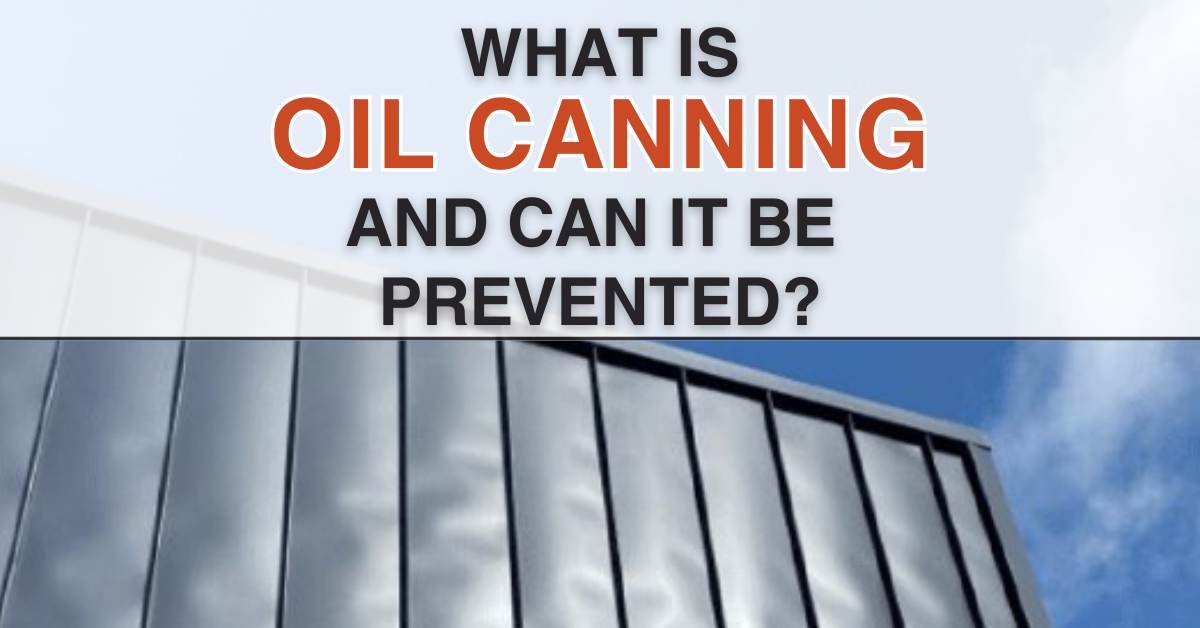
Oil canning is a waviness or rippling that shows up in flat metal panels. You might see it on a standing seam metal roof, metal fascia, or siding. The good news is that it is purely a cosmetic issue, meaning it affects how your roof looks, not how it performs.
The temperature outside during your roof replacement doesn’t increase or decrease your chance of oil canning if installed properly. However, if your roof is installed in winter, you might not notice any oil canning until summer due to thermal expansion and contraction. As temperatures change, metal moves. That movement can make the waviness more or less visible depending on the season.
Sunlight also plays a big role in how visible oil canning is. At certain times of the day, when the sun hits the roof at a low angle, you may see rippling very clearly. Other times, when the light is different, the same roof may look perfectly smooth.
What Causes Oil Canning?
There are several causes of oil canning on metal roofs, and it is important to understand that more than one factor can be at play simultaneously. The most common causes include:
- Thermal Expansion (primary cause of oil canning). Metal will expand by around 1/8 inch per 10 feet from cold to direct sunlight in our climate. Aluminum's expansion will double that amount. Knowledgeable installers will take many measures to control that expansion, but there are a few variables you can't always control. For instance, uneven heat, such as a metal sheet being partially shaded, will cause ripples due to varying expansion across the sheet. Or the flat part of the sheet will get hotter than the vertical rib, and since it's uneven, the middle will tend to get wavy.
- Fastening too tightly. When panels are secured without leaving room for the metal to expand and contract, the stress shows up as rippling. Proper standing seam installation uses clips and nail slots that allow the panel to float, rather than fasteners driven straight through the panel.
- Uneven roof deck. Metal panels are thin and reveal everything underneath them. If your roof deck has dips, bows, or anything poking up, you will see it through the panel. Older homes are especially prone to this. The only real fix is to reframe and flatten the deck before the metal goes on—but even with this step, achieving a perfectly flat deck isn’t always possible.
- Thinner metal. A 26-gauge panel is more likely to oil can than a 24-gauge panel. The thinner the metal, the more it will show movement and stress. Going with a thicker gauge reduces your risk, though it does not eliminate it completely.
- Dark and shiny colors. Dark colors absorb more heat, which means more expansion and contraction. A black, shiny metal roof is going to be your highest-risk choice for oil canning. A matte or textured finish will hide any waviness much better than a glossy one.
- Manufacturing issues. Though rare, the problem can start before the panel even arrives on your roof. If the machine rolling out the panels is not set up correctly, it introduces stress into the metal that will show up as oil canning. Many roofing contractors, including our team, roll panels on-site, which means the installer is also the manufacturer in that case.
How Can You Tell If Oil Canning Is a Manufacturing Defect?
If you see oil canning that repeats at a consistent interval, such as a dimple or wrinkle every two feet all the way up the panel, that can be a sign of a manufacturing defect. This could also be overtightened fasteners, which are normally spaced equally along the panel. When the waviness is random and scattered, it is more likely caused by the roof deck, temperature changes, or installation.
If the issue is a confirmed manufacturing defect, it should be covered under the manufacturer's warranty, and the panels should be replaced. Contractors can often catch this during installation. If panels are coming off the roll looking wrong, work should stop until the machine is corrected and the defective panels are removed.
Can Oil Canning Be Prevented?
Here is the honest answer: while you can reduce your risk, there is no guarantee that oil canning will not occur. Anyone who promises you a completely ripple-free metal roof is making a promise that cannot always be kept. What you can do is make choices that put the odds strongly in your favor.
Oil Canning Risk Guide
| Factor | Lower Risk of Visible Oil Canning | Higher Risk of Visible Oil Canning |
| Panel profile | Striated (ribbed) | Smooth/flat |
| Metal gauge | 24-gauge (thicker) | 26-gauge (thinner) |
| Paint finish | Matte or textured | Glossy/shiny |
| Color | Light colors | Dark colors (especially black) |
| Panel width | 12-inch panels | 16-inch panels |
| Roof deck | Flat, engineered lumber | Older or uneven deck |
Choose a Striated Panel
Striations are very minor ribs built into the surface of the panel. They make the panel more rigid and hide any waviness that does occur. The vast majority of standing seam panels sold today include striations for exactly this reason. At Equity Roofing, a striated panel is our standard recommendation. If a homeowner wants a smooth, flat panel instead, that is a special request, and we make sure they understand the tradeoffs upfront and in writing.
Use a Backer Rod on Smooth Panels
If you want a flat, smooth panel, a backer rod is a foam rope attached to the back of the panel in the center. It creates a slight convex shape across the panel, which is far more rigid than a flat surface and significantly reduces rippling.
Go With a Matte or Textured Finish
Glossy paint makes oil canning much more visible. A matte or textured finish breaks up the light reflection and hides any minor waviness much better.
Choose Lighter Colors
Lighter colors absorb less heat, which means less thermal expansion and contraction over time.
Use Smaller Panel Widths
The smaller the span of flat metal, the more stable it tends to be.
Use a Thicker Gauge Metal
24-gauge is the thickest we recommend for standing seam work. Beyond that, the metal becomes very difficult to form and work with. But going from 26-gauge to 24-gauge is a meaningful upgrade in rigidity.
For striation panels, we typically recommend a 26-gauge. This allows homeowners to experience the benefits of standing seam while enjoying the cost savings of thinner-gauge metal.
Start With a Flat Deck
If you are building a new home and planning on a metal roof, make sure your contractor knows it. Using engineered lumber for your rafters, instead of standard dimensional lumber, gives you a much flatter and more consistent surface for the metal to lie on. If every rafter is perfectly straight, your deck is flat, and oil canning becomes far less likely.
Keep in mind, however, that engineered lumber is far more expensive than than standard lumber.
What If Oil Canning Shows Up After Installation?
If oil canning appears after your roof is installed and it is genuinely bothering you, the only way to fix it is to remove and reinstall the panels. There is no patch or coating that corrects waviness in metal. This is why the conversation needs to happen before installation, not after.
A good contractor will discuss the possibility of oil canning with you upfront. If you choose a flat, shiny panel in a dark color, you should know going in that there is a higher chance of some visible waviness.
Questions to Ask Your Roofing Contractor
If oil canning is a concern for you, ask your contractor these questions before any work begins:
- What steps do you take to prevent oil canning on this type of panel?
- Will you be using a striated panel, or will this be a smooth flat panel?
- If I want a smooth panel, will you be using a backer rod?
- How do you fasten the panels so that they can expand and contract?
- Will any disclosure about oil canning be included in my contract?
- How many metal roofs have you installed, and can I see examples?
A contractor who understands metal roofing will be able to walk you through all of this clearly. If they cannot explain their fastening approach or the difference between a striated and smooth panel, that is a red flag worth paying attention to.
Oil Canning Causes
| Cause | What It Looks Like | What to Do |
| Manufacturing defect | Consistent pattern repeating at the same interval (e.g., a ripple every two feet) across the whole roof | Contact your contractor. This should be covered under the manufacturer's warranty, and the panels should be replaced. |
| Roof deck issue | Rippling is concentrated in one area of the roof, often with a consistent pattern within that section | The only real fix is to address the deck itself. Talk to your contractor about what is underneath. |
| Installation error (overtightening) | Waviness spread across the roof, not tied to a specific area or repeating interval | Ask your contractor to review the fastening. Panels may need to be removed and reinstalled with proper technique. |
| Thermal expansion / normal movement | Waviness that appears more in summer or at certain times of day and is less visible in cooler weather or different light | This is expected behavior for metal. If it was disclosed upfront and you chose a higher-risk profile, this may simply be the tradeoff. |
Choosing Your Metal Roof
Oil canning is one of those topics where being informed can be the difference between a positive or negative roofing experience. It’s not something that can be completely avoided in metal roofing, even in the best situations. But with the right panel choice, the right installation method, and an honest contractor who sets expectations upfront, the risk can be kept to a minimum.
If you’re considering a metal roof, your next step is to review our standing seam article, including costs and comparisons for exposed fastener metal roofs. Deciding between these two roof styles will help to narrow down your options before you get started.
At Equity Roofing, we want homeowners in Indiana and Michigan to love their roofs for decades, and that means having honest conversations before the first panel goes on. If you have questions about metal roofing or want to talk through your options, we are happy to help.
%20(9)-1.png?height=200&name=Feature%20Image%20for%20Blogs%20(July)%20(9)-1.png)
.png?height=200&name=We%20Busted%20Roofing%20Myths%20and%20Fact-Checked%20Reddit%20Tips%20(1).png)
Leave a comment.